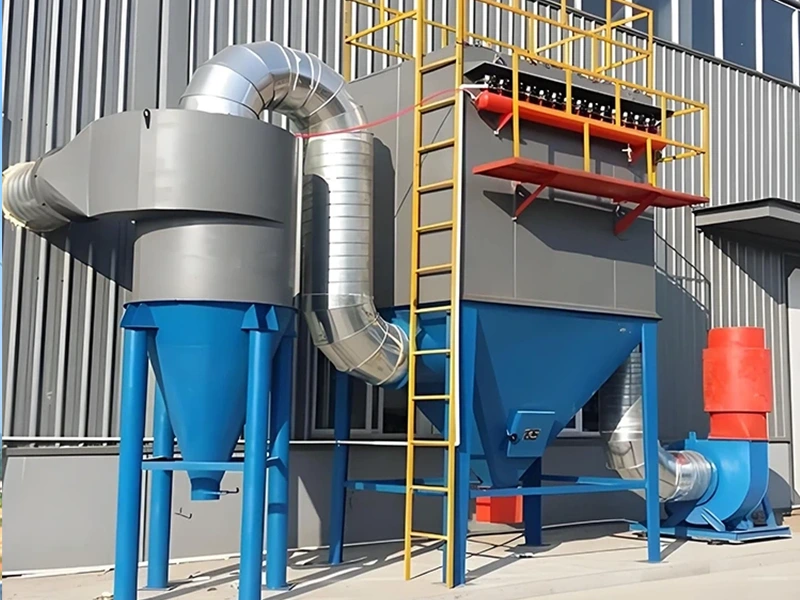
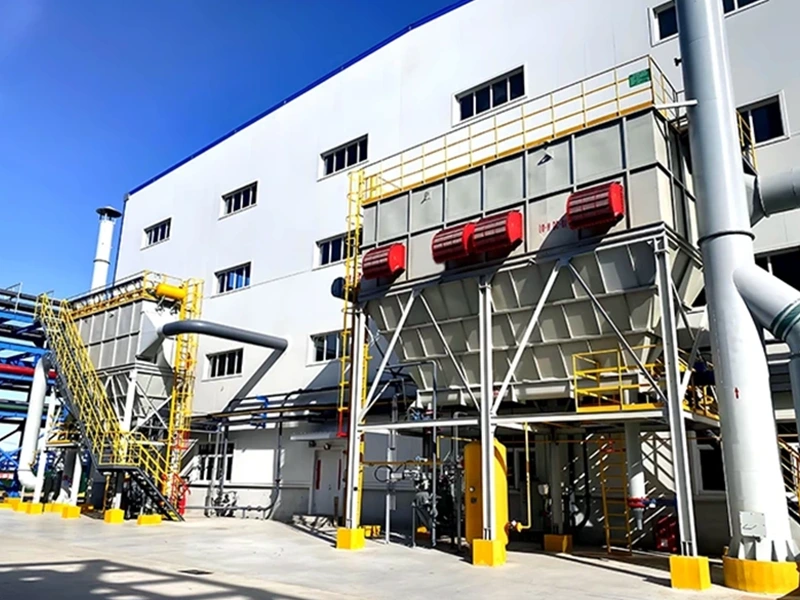
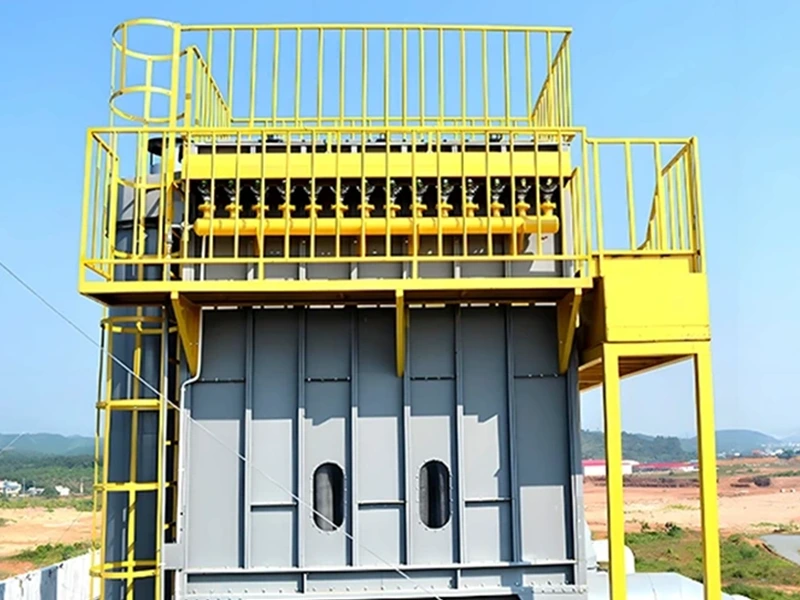
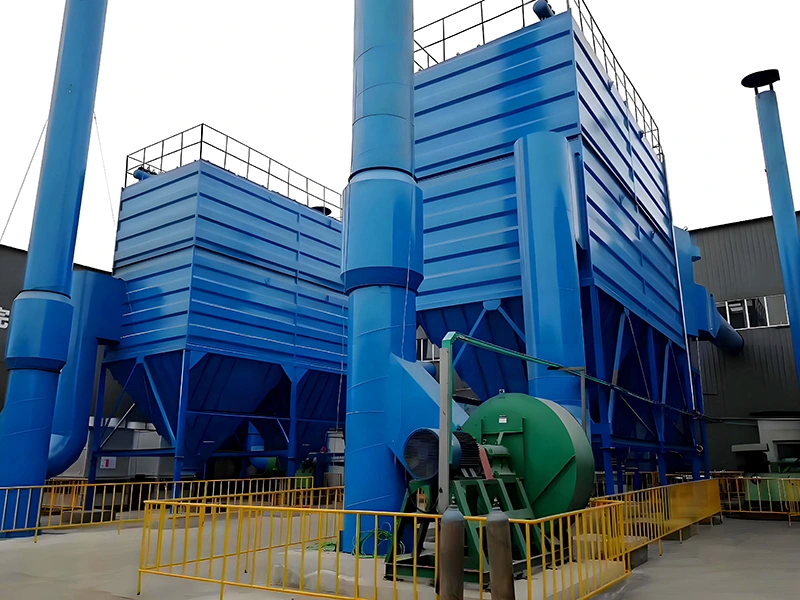
A pulse-jet baghouse dust collector mainly consists of an upper chamber, a middle chamber (containing filter bags and frames), a dust hopper, a cleaning mechanism, a dust discharge device, and a control system. Dust-laden gas enters from the bottom of the middle chamber, rises evenly through guide plates to the filter bags, and large dust particles fall into the dust hopper upon impact. Dust is trapped on the outer surface of the filter bags, while clean gas enters the bags, passes through the bag openings and the upper chamber, and is discharged through the outlet pipe. As dust accumulates on the outer surface of the filter bags, the differential pressure monitoring system sends a signal when the equipment resistance reaches a set value. The cleaning mechanism then activates, and compressed air is ejected from the pulse valve, flowing through the blowpipe and nozzles towards the filter bags. The filter bags instantly expand and vibrate, causing the surface dust to detach and fall into the dust hopper, from where it is discharged through the dust discharge valve. Timed or manual cleaning can also be used. Each chamber of the pulse-jet baghouse dust collector is cleaned sequentially, and the chamber that has completed cleaning immediately resumes dust collection.
Pulse-jet baghouse dust collectors are widely used due to their high dust removal efficiency, adaptability, flexibility, and stable operation. By the end of 2007, Liuzhou Iron and Steel Group (Liugang) had 180 dust removal systems in use or under construction, of which 133 were pulse-jet baghouse dust collectors, accounting for approximately 74% of the total. Coking plants, ironmaking plants, converter plants, refractory material plants, and Lanzi Technology Co., Ltd., among others, extensively use pulse-jet baghouse dust collectors for dust removal, product collection, and air filtration. In the actual operation of pulse-jet baghouse dust collectors, emphasizing maintenance and repair, and promptly identifying and addressing problems can prevent deterioration, save repair costs, and ensure stable operation.
Fault Analysis and Handling Methods of Pulse Jet Bag Filters
1. Poor Dust Removal Effect and Excessive Dust Concentration
Pulse jet bag filters are dust removal equipment. If dust is found emanating from the exhaust pipe outlet after the dust collector, and the dust emission is large, the following aspects can be investigated to find the cause:
(1) The newly installed clean filter bags have large pores. When they are first used, the dust throughput is low, and the filtration state has not yet been reached, resulting in a large dust emission. As filtration progresses, dust accumulates on the outer surface of the filter bags to form a dust layer, which reduces the pores on the outer surface of the filter bags and improves the dust removal efficiency. The "dust-filtering-dust" effect can remove fine dust. Therefore, it is more accurate to measure the dust removal efficiency of pulse jet bag filters after one month of continuous use.
(2) Check whether the filter bags are installed correctly. In a typical pulse jet bag filter, the filter bags are pressed into the holes of the tube sheet by elastic expansion rings sewn to the filter bag openings. The tube sheet strictly separates the dust chamber of the middle chamber from the clean chamber of the upper chamber. If the elastic expansion ring at the filter bag opening fails to seal tightly with the tube sheet hole, resulting in a gap, dust-laden airflow will directly enter the clean air chamber, causing dust to emerge from the exhaust stack outlet. The installation of each filter bag opening should be checked individually, and any gaps should be tightened and sealed. During the installation of a pulse jet baghouse dust collector, the installation quality of the filter bags is one of the key aspects to be monitored and inspected. The ironmaking plant improved and optimized the filter bag installation: a 30mm ring was welded above each tube sheet hole and concentric with the hole. The single-layer elastic expansion ring sewn to the filter bag opening was then installed tightly against the inner wall of the ring. This not only ensured a smooth and sealed installation of the filter bags but also made the installation and disassembly of the filter bags simpler.
(3) Damaged filter bags will cause dust-laden airflow to be directly discharged, resulting in dust emerging from the exhaust stack outlet after the dust collector. For large pulse-jet baghouse dust collectors with offline cleaning, the following method can be used to determine the location of the broken bag: Clean each compartment manually, closing the exhaust valve of one compartment at a time. Observe the exhaust outlet carefully. When the compartment with the broken bag stops filtering, the exhaust outlet will no longer emit dust, thus determining which compartment has the broken bag. If only a few filter bags are damaged, seal the hole in the tube sheet with an iron cap to ensure the emitted dust concentration meets standards. When filter bags need to be replaced, it is recommended to replace all filter bags in the same dust collector simultaneously, ensuring each bag has equal resistance. If only a few filter bags can be replaced, seal the opening of the new filter bags and bury them in the dust for several days to increase their resistance, making it close to that of the old filter bags.
(4) For dust collectors where the inlet and outlet channels are separated only by a partition, check whether the partition is welded tightly. If there are weld seams or gaps in the partition, dust in the inlet air will enter the outlet channel, causing dust to emit from the exhaust outlet. The welding quality of the intermediate partition, which separates the inlet and outlet air ducts, is another aspect of quality inspection during the fabrication and installation of the dust collector.
2. Bag clogging occurs, resulting in high operating resistance in the pulse jet baghouse dust collector.
Operating resistance is a crucial performance indicator for dust collectors. A well-functioning pulse jet baghouse dust collector should not only remove dust but also maintain an operating resistance below 1500 Pa. If the dust adhering to the filter bags cannot be removed during cleaning, the dust gradually accumulates and clogs the outer surface of the filter bags, making them prone to damage. This not only increases the operating resistance of the dust collector but also increases the operating load on the dust collector fan, leading to higher operating costs. Performance tests on dust collectors used at Liuzhou Steel revealed that the operating resistance of some pulse jet baghouse dust collectors exceeded 1500 Pa, with some even reaching 3000 Pa, indicating poor operating conditions. Installing a differential pressure detection alarm device on the dust collector can conveniently monitor its operating resistance. If the operating resistance of a pulse jet bag filter is found to be outside the control range, the following factors should be considered to troubleshoot the problem:
(1) Short cleaning time and excessively long cleaning cycle: Dust on the filter bags is not completely removed before the dust collector switches to filtration mode, causing a rapid increase in operating resistance. For pulse jet bag filters, the cleaning time (i.e., the pulse valve blowing time) is the cleaning time, which is adjustable within the range of 0.05–0.5 s. The interval between two cleaning cycles is the cleaning cycle, generally 0–30 min. Adjusting the cleaning regime of the pulse jet bag filter, appropriately extending the cleaning time, increasing the amount of compressed air and induced air injected into the filter bags; simultaneously shortening the cleaning cycle or even adopting a continuous cleaning method can shorten the filter bag cleaning time and reduce operating resistance. (2) When a pulse-jet baghouse dust collector handles warm and humid gases, if the gas temperature is below the dew point during operation, water vapor will condense, causing the filter bags to become damp. A large amount of dust will adhere to the surface of the filter bags, clogging the pores, and the compressed air cannot effectively clean them, resulting in filter bag clogging. A clogged filter bag will cause the dust collector's cleaning function to fail, resulting in excessive resistance and deteriorating operating conditions. To prevent condensation and clogging in a pulse-jet baghouse dust collector, the air temperature should be maintained at its dew point of 25–35°C. When using the dust collector to handle warm and humid gases, a temperature detection alarm device should be installed at the inlet for monitoring, and insulation materials such as rock wool should be added to the outside of the casing for insulation. Before stopping the dust collection system, the humid gas inside the dust collector should be discharged and replaced with dry air to prevent condensation. In other words, after the production equipment stops operating, the dust collector fan should run for an extended period before being shut down.
(3) Pulse jet baghouse dust collectors typically operate under negative pressure. If the equipment leaks, it will draw in a large amount of outside air and rainwater, causing the filter bags to become damp and cake, increasing operating resistance. Therefore, the dust collector must be strictly sealed, with a leakage rate of less than 3%. Welding quality is crucial during equipment installation. All welding must be carried out according to relevant specifications and standards. After welding, leak checks should be performed using kerosene and fluorescent powder; any leaks should be re-welded. Inspection doors of the dust collector should be sealed with rubber strips and checked and replaced frequently. Carefully inspect all unloaders and flanges, ensuring proper sealing. Reducing air leakage can protect the filter bags from caking, allowing the equipment to operate smoothly with lower resistance.
(4) Pulse jet baghouse dust collectors generally use compressed air for cleaning. Compressed air contains a lot of oil, water, and impurities. If sprayed directly into the filter bags without purification, the filter bags will become contaminated and damp, leading to condensation. If the dust collector handles warm, humid gas, the introduction of cold compressed air will cause condensation on the filter bag surface if the temperature reaches the dew point. This condensation will then adhere to a large amount of dust, leading to caking. To prevent impurities in the compressed air from causing bag caking, a work system should be established and implemented, consistently opening the drain valves of the air tank, air source triplet, and pulse valve manifold daily to remove oil, water, and other contaminants. A refrigerated dryer and heater can be installed before the pulse valve manifold to further dehydrate and heat the compressed air before it is injected into the filter bags for cleaning.
3. Electromagnetic Pulse Valve Leakage
The electromagnetic pulse valve is a key component of a pulse jet baghouse dust collector, considered its "heart," and its performance directly affects the dust collector's operation. Leakage is one of the common faults of electromagnetic pulse valves. Once leakage occurs, the air pressure in the manifold drops, all pulse valves in the dust collector will fail to operate, the dust collector's operating resistance will continuously increase, and the ventilation volume will decrease. Common causes of air leakage in electromagnetic pulse valves include:
(1) Damage to the diaphragm of the electromagnetic pulse valve. Close the valve before the air distribution manifold of the pulse valve, open the pulse valve to check, and if the diaphragm is damaged.
(2) Rust, welding slag, or other debris between the diaphragm gasket and the outlet end face prevents a tight seal, leading to air leakage in the electromagnetic pulse valve. Open the pulse valve to remove the debris. During the installation of a pulse bag filter, first purge the compressed air pipeline to remove rust, welding slag, and other debris before installing the pulse valve and air distribution manifold. This can prevent air leakage caused by debris blockage.
(3) For submerged pulse valves, if there is a leak in the blowpipe in the air manifold, compressed air will leak directly into the blowpipe without passing through the pulse valve. Timely repair or replacement of the blowpipe will prevent air leakage in the pulse valve.
Pulse bag filters are widely used and have become the mainstream dust removal equipment. If a fault is discovered during use, as long as the analysis is accurate and the handling is timely, the pulse bag filter can operate smoothly, reduce operating resistance, extend the service life of the filter bags, and reduce the amount of air used for cleaning. This allows for high efficiency with low operating costs, leveraging the advantages of the pulse bag filter to achieve economical and efficient dust removal.
We use cookies to offer you a better browsing experience, analyze site traffic and personalize content. By using this site, you agree to our use of cookies. Privacy Policy